DOT Physical Vision Requirements: The Complete Guide for CDL Drivers
CDL drivers need 20/40 corrected vision in each eye, a 70° horizontal field of view, and color recognition. Monocular drivers can apply for an exemption.
What you need to know: To pass the vision portion of your DOT physical, you need at least 20/40 vision in each eye (corrected is fine), a horizontal field of view of at least 70°, and the ability to distinguish traffic signal colors. Monocular drivers can't certify under standard rules but can apply for an FMCSA vision exemption.
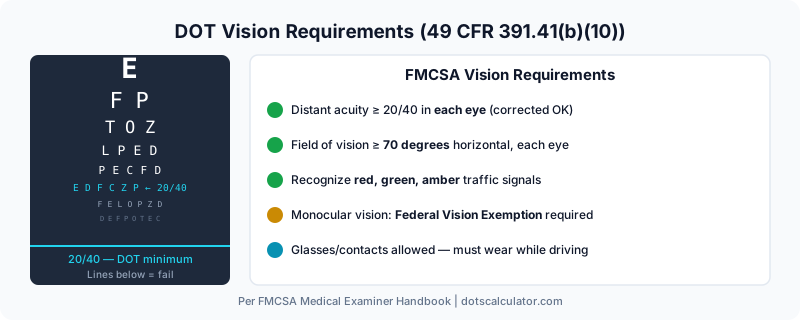
The FMCSA Vision Standards at a Glance
Vision requirements for commercial drivers are spelled out in 49 CFR 391.41(b)(10). Here's exactly what the regulation says you need:
- Distant acuity: 20/40 or better in each eye, with or without correction
- Field of vision: At least 70° in the horizontal meridian in each eye
- Color recognition: Ability to recognize the colors of traffic signals (red, green, amber)
- No condition that interferes with safe driving: This is a catch-all that covers certain eye diseases and conditions
The vision test is done by the medical examiner during the physical. They'll use a standard Snellen chart or a vision testing device. If you wear glasses or contacts, you take the test with them, and if you pass only with correction, your medical certificate will note "corrective lenses required."
Check your other DOT physical criteria alongside vision at the DOT physical eligibility checker before your exam.
What 20/40 Vision Actually Means
The Snellen notation works like this: 20/40 means you can read at 20 feet what a person with normal vision can read at 40 feet. It's not great vision, but it's functional for safe driving.
For reference:
- 20/20 = normal vision
- 20/40 = the minimum for CDL certification; roughly what most states require for a standard driver's license
- 20/70 = you'd need glasses to drive legally in most states
- 20/200 = legally blind in the United States
The standard applies to each eye individually. You can't average them. If your right eye is 20/20 and your left eye is 20/60 corrected, you fail, even though your better eye is perfect. Both eyes must clear 20/40.
This is the part that catches some drivers off guard. They've been driving on a standard license for years with one strong eye compensating for a weaker one, and they don't realize the CDL standard tests both eyes separately.
Corrected vs. Uncorrected Vision
The regulation allows correction, meaning glasses or contacts. If you need lenses to hit 20/40, that's fine. You'll just have "corrective lenses required" noted on your medical certificate and CDL.
What this means practically: you must wear your correction every time you're behind the wheel of a CMV. No getting in the cab without your glasses because you left them in the truck stop. That notation on your certificate is a legal requirement, and driving without correction when it's required is a violation.
If you wear contacts, it's worth having a backup pair of glasses available. A lost contact lens on a long haul shouldn't be a safety issue.
Get an eye exam before your DOT physical if your prescription is more than a year old. Vision changes gradually, and a prescription that got you to 20/40 two years ago might not do it today. New glasses or contacts take a week or two to obtain, don't wait until you're sitting in the examiner's chair to find out yours are outdated.
The 70° Field of Vision Requirement
Field of vision (also called visual field) refers to how wide a range you can see without moving your eyes. The FMCSA requires at least 70° in the horizontal meridian in each eye.
Normal field of vision is roughly 60° inward (toward the nose) and 90°–100° outward (toward the ear) per eye. The FMCSA minimum of 70° horizontal per eye is not a very high bar, most people with otherwise normal eyes clear it easily.
Where field of vision becomes relevant: certain conditions can reduce it. Glaucoma is the most common. Advanced glaucoma causes peripheral vision loss, and if it progresses enough, it can drop your horizontal field below 70°. Retinal detachment, certain neurological conditions, and some medications can also affect visual field.
If the examiner has any reason to suspect a visual field problem, you've mentioned glaucoma, or your eyes aren't tracking normally, they may refer you to an ophthalmologist for formal perimetry testing before certifying you.
Color Recognition: The Traffic Signal Standard
The regulation requires that you can recognize the colors of traffic control signals. It doesn't require "normal" color vision, only that you can distinguish red, green, and amber (yellow).
The medical examiner typically tests this with Ishihara color plates during the exam. These are the circular dot pattern cards you may have seen at eye doctor offices. They're designed to identify red-green color deficiency.
Here's the important nuance: about 8% of men have some form of color vision deficiency (most commonly red-green). Many of them can still pass the DOT color test because the standard is functional, can you identify traffic signals?, not clinical. Some color-deficient drivers pass the Ishihara plates with no problem. Others fail the plates but can still correctly identify signal colors by brightness and position.
If you fail the Ishihara test, the examiner may use an alternative test, like asking you to identify colored lights, before making a determination. A referral to an ophthalmologist or optometrist for formal color vision testing may also be appropriate.
Conditions That Can Affect Your DOT Vision Certification
Several eye conditions are worth being aware of before your exam:
Diabetic retinopathy, Diabetes can damage retinal blood vessels, eventually affecting both acuity and visual field. Drivers with Type 2 diabetes (especially those on medication) should have a current ophthalmology report available showing visual acuity and retinal health. See our post on diabetes and DOT physicals for the full picture.
Glaucoma, If managed and stable, many drivers with glaucoma still meet the 20/40 and 70° standards. The question is whether it's progressed enough to drop below the threshold. A recent ophthalmologist's report stating your current acuity and visual field measurements is the best documentation to bring.
Cataracts, Untreated cataracts can reduce acuity below 20/40. Post-surgery cataracts, with appropriate corrective lenses, typically don't cause problems.
Macular degeneration, Depending on severity, this can reduce central acuity below 20/40. Early stages may not affect certification; more advanced disease may.
Monocular vision (one functional eye), This is the most significant vision-related situation for CDL drivers. Standard regulations require two functional eyes meeting the 20/40 standard. Drivers with vision in only one eye cannot certify under standard rules.
Monocular Drivers: The FMCSA Vision Exemption
Having vision in only one eye, whether from disease, injury, or a condition present since birth, doesn't automatically end a driving career. The FMCSA has a Vision Exemption Program specifically for monocular drivers.
To qualify for the exemption, you need:
- At least 20/40 vision in the functional eye
- A demonstrated ability to safely operate a CMV (the program reviews driving history, crash records, and physician attestation)
- No other disqualifying conditions
The exemption application process is more involved than a standard medical certificate. You submit to the FMCSA directly, and the agency reviews your driving record, your vision documentation, and typically requires a recommendation from a licensed ophthalmologist or optometrist. Processing takes several months.
If approved, the exemption is renewable and allows you to operate under the same rules as two-eyed drivers, with the condition documented on your CDL.
It's not a guarantee, the FMCSA evaluates each application individually. But thousands of drivers have obtained vision exemptions and are operating legally today. Don't assume it's impossible before you apply.
What to Bring to the Exam if You Have Eye Conditions
If your vision situation is anything other than "I wear glasses and see fine," bring documentation:
- Current eyeglass or contact prescription, Issued within the past 12 months is ideal
- Ophthalmologist report, For any diagnosed eye condition: glaucoma, diabetic retinopathy, cataract history, etc. The report should include corrected visual acuity in each eye and visual field measurements if relevant
- FMCSA exemption documentation, If you're operating under a vision or monocular vision exemption, have the current approval letter on your person during the exam
An examiner who sees documentation showing your condition is monitored and stable is more likely to certify you confidently than one who has to make a judgment call without information.
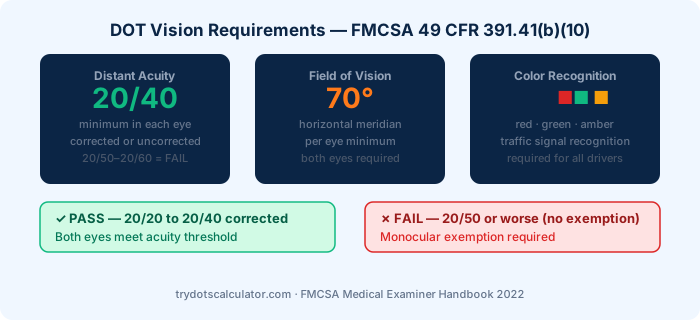
The Vision Test Is Quick, Don't Let an Old Prescription Trip You Up
For the majority of drivers, the vision portion of a DOT physical takes under five minutes. Read the chart, pass the color test, confirm your field of vision looks normal, done.
The most common reason drivers run into trouble isn't disease, it's a prescription that's no longer adequate. Glasses or contacts from three years ago that put you at 20/50 now instead of 20/35. It's a completely preventable outcome.
Go to an optometrist or ophthalmologist before your DOT physical if you haven't had an eye exam in the past year. A new prescription typically takes 7–14 days for glasses, or 1–3 days for contact lenses. Build that time into your prep calendar.
Before your exam, use the DOT medical certificate calculator to check all your qualifying factors, blood pressure, BMI, and vision, against the actual FMCSA standards. It takes 90 seconds and tells you where you need to focus your prep.
Don't let something as manageable as an outdated eyeglass prescription stand between you and your medical card. If you've got a chronic eye condition, get it documented and bring the paperwork. Most vision-related issues at DOT physicals are resolved before you walk in, not at the exam table.
For a full overview of everything that gets checked at a DOT physical, including blood pressure stages and their effect on cert length, check out our guide to preparing for your DOT physical exam.